Wedding Invitation Messages in English and Hindi
Wedding invitation messages in English and Hindi together: bilingual card lines, paired English and Hindi messages, WhatsApp lines and layout tips.
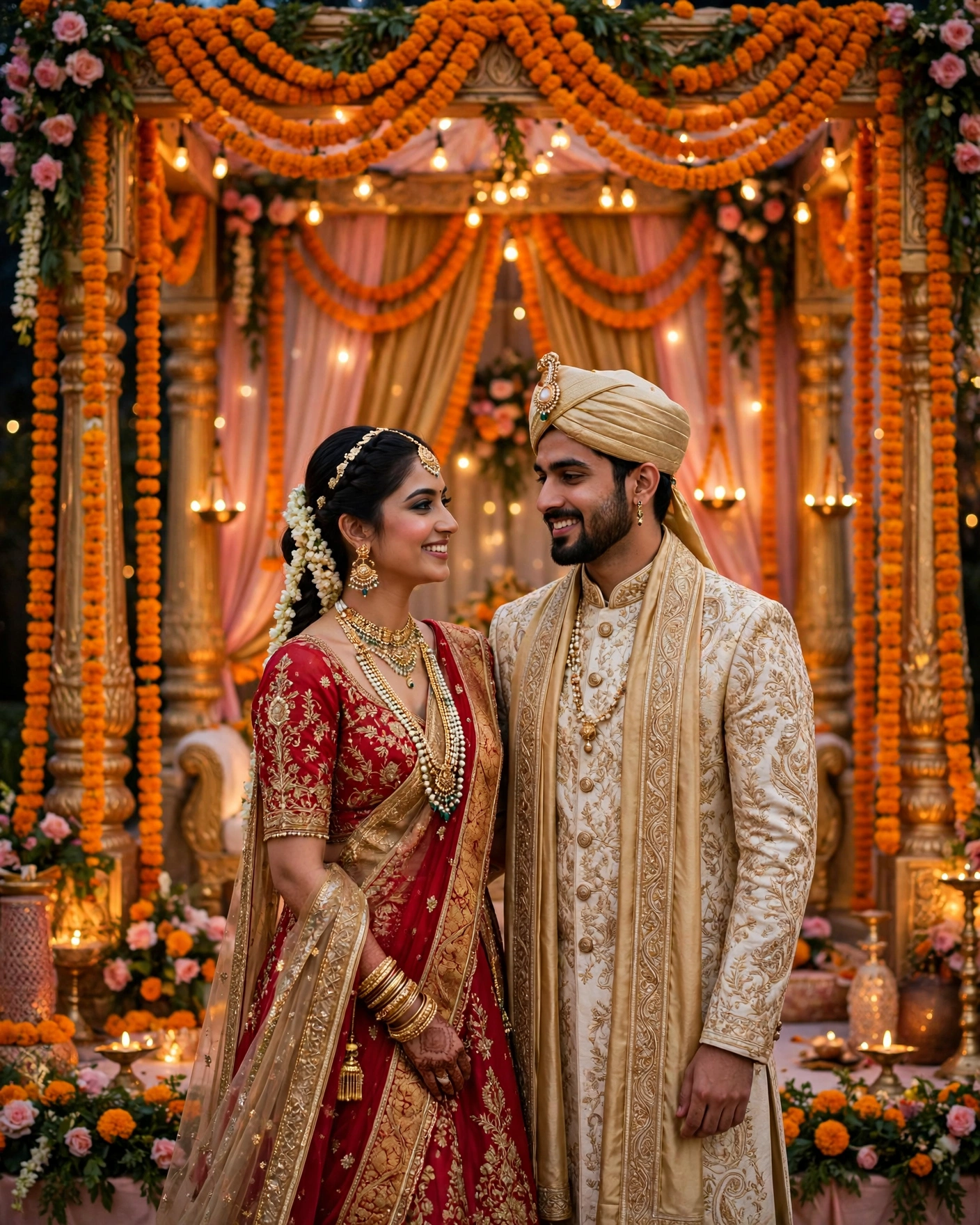
Wedding invitation messages in English and Hindi
A bilingual invitation lets every guest read it comfortably: Hindi carries the blessing and the warmth, English carries the details for guests who read it more easily. Below are paired messages, bilingual card lines and WhatsApp messages. Tap Copy and replace the words in brackets.
Bilingual card lines
- ॥ शुभ विवाह ॥ With the blessings of our elders, we invite you to the wedding of [Bride] and [Groom].
- आपकी उपस्थिति प्रार्थनीय है। Your presence is requested at the wedding on [Date], [Venue], [City].
- सपरिवार पधारें। Please join us with your family.
- वर-वधू को आशीर्वाद दें। Please come and bless the couple.
Paired messages: English, then Hindi
- With joy, we invite you to the wedding of our daughter [Bride] with [Groom].
- हर्ष के साथ हम आपको अपनी सुपुत्री [वधू] के [वर] के साथ शुभ विवाह में आमंत्रित करते हैं।
- Your blessings will make our celebration complete.
- आपका आशीर्वाद हमारे उत्सव को पूर्ण करेगा।
- Please join us for the pheras at [Time], followed by lunch.
- फेरे [समय] बजे, उसके पश्चात भोजन।
Bilingual lines for each function
- हल्दी · Haldi: [Date], [Time], [Venue]
- मेहंदी · Mehendi: [Date], [Time], [Venue]
- संगीत · Sangeet: [Date], [Time], [Venue]
- प्रीतिभोज · Reception: [Date], [Time], [Venue]
WhatsApp messages
- Namaste [Name] ji! शादी का निमंत्रण: [Bride] weds [Groom], [Date], [City]. All functions and maps: [link]
- Shubh Vivah! Humari beti [Bride] ki shaadi [Date] ko hai. Please join us with family. [link]
- Aap sapariwar zaroor aaiye. The full invite with every function is here: [link]
Designing a bilingual invitation
- One language per line. Mixing within a sentence is hard to read; alternate lines or panels instead.
- Hindi first for the blessing. Traditional cards open with the Hindi invocation, then move to English.
- Details in both, or in English. Dates and venues in English reach everyone, including guests who don't read Devanagari.
- Match the fonts. Choose a Hindi and an English font that look like they belong together.
- Check both on a phone. Devanagari needs a little more size to read comfortably on small screens.
A bilingual invitation says something beyond its words: everyone is welcome here.

Before you send
- The Hindi read aloud by a fluent reader
- Names spelled the same way in both scripts
- Dates and venues identical in both languages
- Both scripts readable on a phone
More paired lines
- We look forward to welcoming you.
- आपके स्वागत की प्रतीक्षा रहेगी।
- Please bless the newlyweds.
- नवदंपति को आशीर्वाद दें।
Choosing the layout
A bilingual card can be laid out in three ways. Side by side, with Hindi on the left and English on the right, works well for printed cards and keeps the two equal. Top and bottom, with the Hindi blessing above and the English details below, is the most common and the easiest to read on a phone. Alternating lines, a Hindi line then its English meaning, suits short invitations but gets long quickly. Whichever you choose, use the same order for every function, so guests always know where to look for the date and venue.
Fonts that work together
Pair a Hindi font and an English font of similar weight and style: a classic serif with a traditional Devanagari, or a clean sans-serif with a modern one. Avoid decorative Hindi fonts that break conjunct letters on phones.
When guests speak other languages
If some guests read neither Hindi nor English comfortably, for example relatives from the South or abroad, keep the date, time and venue in numerals and simple English, and add the map link. A short line in their language, even a greeting, is a warm gesture that shows you thought of them.
Frequently asked questions
Can a wedding invitation be in both English and Hindi?
Yes, and it's very popular. Most families use Hindi for the blessing and English for the details, or show both side by side.
Which language should come first?
Traditionally the Hindi blessing comes first, at the top. The details can follow in English or in both languages.
How do I keep names consistent in two scripts?
Decide the English spelling and the Devanagari spelling of each name once, and use them everywhere: the card, the invite and the venue board.
Is Roman Hindi okay on a bilingual invitation?
Yes, especially for WhatsApp. Roman Hindi reads quickly on phones and reaches guests who speak Hindi but read Devanagari slowly.
Related reading
- Wedding Invitation Wording: Examples for Every Function
- Wedding Invitation Messages in Punjabi
- Wedding Invitation Messages in Urdu
Create your wedding invitation on MyIndiAura, in English, Hindi or both side by side.
See it on a real invite
Open any of these to see the full invite, then add your own names and preview it free.


Found this useful? Share it with someone planning a celebration.
Share